Introduction
Self-determination is an important skill for students to develop as they move through high school. One opportunity to exercise it is in the college admissions process, where they may decide to disclose their disability, or not. That decision should be informed by facts, not conjecture.
Facts are especially important when it comes to the decisions IEP teams make while students are still in high school. Students should have a voice, and the rest of the team should also have the right facts when making decisions about students’ services.
I have taken some of the myths I commonly hear and addressed the assumptions they make about the admissions process, hoping it will help students decide what they would like to do.
Myth 1 – Students should be moved from an IEP to a 504 plan for senior year because it “looks better” when they apply to college
Colleges aren’t allowed to ask students applying for admission whether or not they have a disability (this is in the start of Section 504 Subpart E, the part of the law that gives colleges their mandates.) Therefore, colleges don’t ask what kind of plan students have. And even if students choose to disclose their disability when they apply, colleges still won’t ask whether they have an IEP or 504 plan. Therefore, IEP teams should not let students’ plan to attend college (and their decision about disclosure) change the kind of plan they’re on as seniors, or take their services away because they’re worried about how it might affect their chances of getting into college.**
For more on this particular myth, read my post for Understood – “Do colleges view 504 plans better than IEPs?”
Have you heard 504 plans are valid at college? It’s not true.
Myth #2 – High school students should get off any kind of plan (IEP or 504) and stop using special education services and accommodations because it will show on their record, and this will hurt their chances at being admitted to college
Again, colleges can’t ask students about disabilities, but even if they know they won’t say anything, students may wonder whether materials sent by their high school may mention that they had services or accommodations. They should know that it is against the law for transcripts to state that students had an IEP or 504 plan (unless students took classes with a modified curriculum). See questions 7-9 of this FAQ from the Office for Civil Rights to learn more about transcripts.
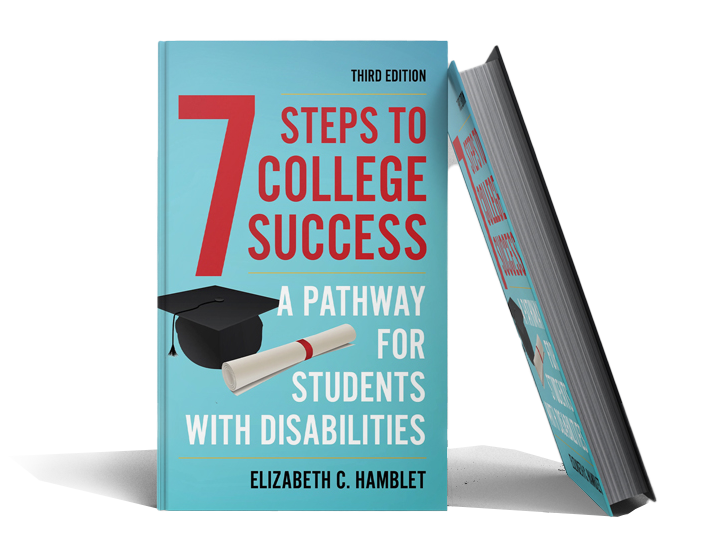
That said, if a student receives credit for a study skills class that is only for students with disabilities, college admissions departments may understand that from the title of the class. But no one should assume they’d view this negatively. (If you want to see what a college admission dean said about how they look at such classes, read Step 6 of my book.)
So students should not stop using accommodations and services they need in high school fearing that this would be indicated in the school’s materials. And even if they take a support class that will appear on their transcript, they should not assume this will negatively affect their chances.
Myth #3 – Students should disclose their disability when applying to college because there’s a quota of students with disabilities each college has to accept
I hear the quota rumor a lot. It isn’t true, but this doesn’t mean that students who want to disclose their disability should be discouraged from doing so.
*Read Step 6 of my book to see what admissions deans said about disability disclosure in the admissions process and these posts, videos, and podcasts for to learn more about the admissions process.
Myth #4 – Students should not disclose their disability in their college application because it puts them at a disadvantage
Statements like this assume that every reviewer at every college sees students with disabilities as less capable than their typical peers. This is a generalization people should not make, and it’s not based on evidence.*
When evaluating such claims, just know that there is no publicly available data showing how many students who disclosed a disability while applying to College X did or didn’t get admitted (and it is unlikely College X even collected it). Remember that:
- colleges aren’t allowed to ask students whether they have a disability, and
- not every student who has a disability will disclose that when applying to college
So even if College X did collect data like this, they’d only know how many of the students they accepted (or didn’t) had said they had a disability. They would not know how many of those they had accepted or rejected had a disability and didn’t disclose that information when they applied.
You may find statistics informative. According to the most recent statistics collected by NCES, 20.5% percent of students attending college in the 2019-2020 academic year reported having a disability—but no one knows how many disclosed their disability when they applied. We can’t estimate how many did so, but—statistically—it seems likely that some of them did. (I’ve met some students over the years who said they did disclose and got into their college of choice.)
This means that statements about disclosure damaging students’ college admission prospects are based on assumptions not backed by data; keep that in mind as you consider such advice. If someone who works in admissions at College X tells you how College X views students with disabilities, then take what they say as applying only to that school. Don’t generalize that to apply elsewhere.
Myth #5 – If students haven’t met colleges’ admission criteria, they should disclose their disability because colleges have to adjust their requirements for students with disabilities
Colleges can always choose to accept students who don’t meet their requirements (and, anecdotally, I’ve heard from students who have been accepted who hadn’t met them at certain colleges), but they are not required to do so. Students may decide it’s worth disclosing anyway. They should just be aware that doing so may not make a difference if the college holds tightly to its entrance requirements.
Myth #6 – Students who don’t want to disclose their disability when they apply to college should do so anyway because some colleges seek a diverse student body and they’ll be at an advantage
Colleges may be looking to accept more students with disabilities, but no one can tell students how much better their chances of admission will be they might if they disclose. (Again, there are no statistics that count these admissions/rejections.) This is not meant to discourage students who want to disclose from doing so. It just means if that if students decide for any reason they don’t wish to disclose, they shouldn’t be pushed to do so based on this idea.
Myth #7 – If students disclose their disability and don’t get into College X, the sole reason for their rejection was that they have a disability
Once again, statements like this can’t be supported by data. There can be so many reasons why a student with or without a disability gets into a college in any given year. Perhaps the college has created a new major at the school and they are trying to grow it, or the field hockey team needs a goalie. That may not be a big comfort if it’s the college they hoped to attend, but students should not regret their decision to disclose because someone told them that that was the reason they weren’t admitted.
To learn about the institutional priorities that drive admission decisions, read The Truth About College Admission: A Family Guide to Getting In and Staying Together and Who Gets In and Why: A Year Inside College Admissions by Jeff Selingo. You’ll find both books illuminating and helpful. You can see them in my list of recommended books about college admission (along with others) and booklists on other topics in my affiliate accounts in Amazon or Bookshop.org, where you can support an independent bookstore if you don’t have one nearby.
Myth #8 – Students shouldn’t use accommodations on the SAT or ACT because the score report will indicate that they did so and this will negatively affect their admission prospects.
Neither testing board makes a notation on students’ score reports at this time. However, students may be interested to know that students brought a class action suit against the ACT a few years ago for revealing students’ disability information to colleges and scholarship organizations.
One last point
** Teams should also know that there is no reason to send students’ IEP or 504 plan with their application. Colleges don’t ask to see these as part of the admissions process, except at a few colleges that offer fee-based programs for students with learning disabilities and ADHD where they apply to both simultaneously. See Step 5 of my book for more on this.